
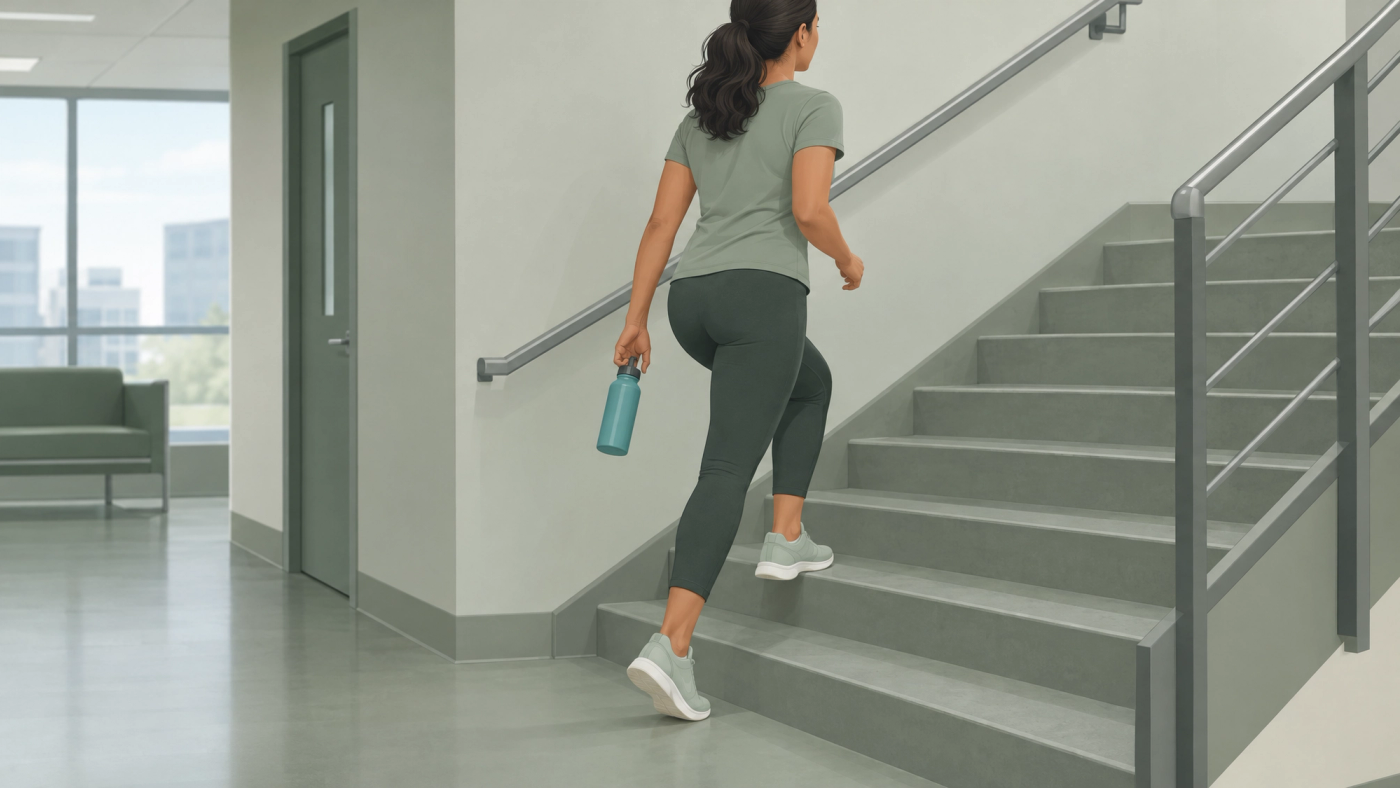
Exercise-snacks consisting of 3–6 daily bouts of stair climbing, brisk walking, squats, push-ups, or stretching; each bout lasted 1–3 minutes at moderate-to-vigorous intensity, totaling approximately 10 minutes per day.
Exercise Snacks
Exercise Snacks, Blood Pressure and Stress Trial
A 12-week randomized trial in office workers tested brief bouts of stair climbing, walking, bodyweight exercises, or stretching across the workday. About 10 minutes daily was linked with lower blood pressure and perceived stress.
Study overview
- Study title
- Workplace-embedded exercise-snack to interrupt sedentary work: A 12-week randomized trial on blood pressure and perceived stress with implementation implications.
- Study authors
- Keyi Liu, Xiao Liang
- Population
- Office workers in a workplace setting
- Sample size
- 52
- Duration
- 12 weeks
- Comparator
- Control group
- Outcomes
- Systolic blood pressure, Diastolic blood pressure, Perceived stress, Body mass index
Intervention
Main findings
At week 6, significant group-by-time effects were observed for systolic blood pressure and perceived stress, but not diastolic blood pressure or BMI. By week 12, the intervention group had lower systolic and diastolic blood pressure and perceived stress from baseline, while BMI did not change significantly.
What this may mean in practice
Snacksmate's reading of the evidence — not a quotation from the original paper.
In office workers, spreading about 10 minutes of brief moderate-to-vigorous activity across the workday was associated with lower blood pressure and perceived stress over 12 weeks. The study did not establish a change in BMI.
Original study
What can you take from this?
The notes above are Snacksmate’s reading of this study, not personal advice.